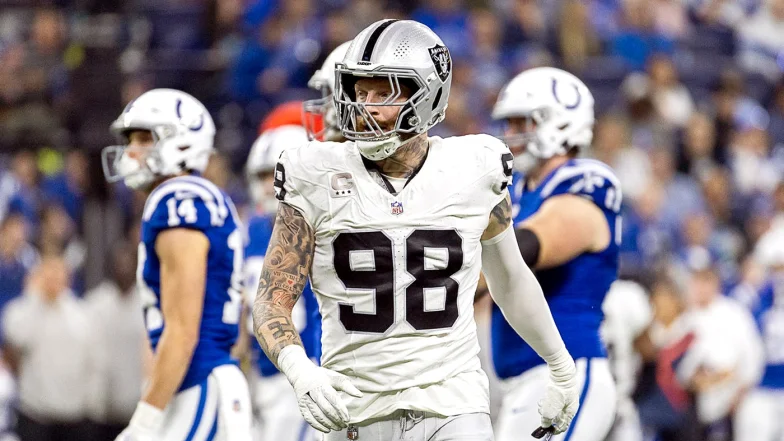
Trading for Crosby to pair with Bosa would fix the 49ers' pass rush, but it's a bold win-now gamble counter to San Francisco's recent roster strategy.
The San Francisco 49ers are "nuclear hot" to trade for Las Vegas Raiders edge rusher Maxx Crosby, Raiders on SI reporter Hondo Carpenter said on a recent episode of the "Las Vegas Raiders Insider Podcast." Carpenter reported "a lot of interest" in the five-time Pro Bowl selection and named the 49ers and Philadelphia Eagles as the two teams most likely to pursue a deal for one of the NFL's top defensive ends.
San Francisco's interest is easy to justify after the 49ers finished the 2025 season with an NFL-low 20 sacks. With fellow edge rusher Nick Bosa returning from a torn ACL and 2025 first-round draft pick Mykel Williams rehabbing a knee injury of his own, a healthy Crosby would immediately transform the 49ers' otherwise questionable defensive line into one of the most dangerous units in the league.
But several factors make a deal unlikely in the near future, and the practical obstacles are substantial.
The complications begin with the cost. Crosby signed a three-year, $106.5 million extension with the Raiders in 2025 and is under contract through 2029. With cap charges of roughly $36 million in 2026 and $30 million in 2027, any team trading for him would have to absorb or restructure a major contract while also surrendering premium draft capital to Las Vegas.
The 49ers have the necessary salary cap flexibility for such a transaction. Earlier this offseason, they restructured Bosa's contract, clearing over $17 million in 2026 cap space. Bosa is still scheduled to count roughly $23 million against the NFL's salary cap this season, with that figure climbing to nearly $55 million in 2027. Stacking Crosby's salary on top would tie up an enormous share of San Francisco's spending at one position.
Similar to Bosa, Crosby turns 29 later this year, which factors heavily into calculations for any team considering surrendering high-value picks for a previously established commodity. A playoff contender would need to be comfortable trading for an elite impact player still in his prime—but closer to the end than the beginning.
The medical piece matters just as much. Crosby underwent surgery on a torn meniscus in his left knee in January after finishing the 2025 season on injured reserve. The procedure was reported as a meniscus repair rather than a trim—a more complex fix, with a recovery timeline typically measured in months rather than weeks.
The knee injury already cost the Raiders one deal earlier this year. In March, Las Vegas agreed to send Crosby to the Baltimore Ravens for first-round picks in 2026 and 2027, but Baltimore backed out after Crosby's failed physical resulted in concerns over his long-term outlook.
That failed trade remains an important piece of context. It shows the Raiders were willing to move Crosby, despite later public indications that they planned to retain him. It also demonstrates the level of difficulty associated with a blockbuster trade when the price pairs multiple premium picks with a major contract for an elite player recovering from surgery.
Although it is likely the 49ers are interested in adding Crosby to their roster, any current offer probably falls well short of Baltimore's abandoned price.
Despite interest—nuclear or otherwise—significant barriers maintain the situation where it currently stands. San Francisco could view Crosby as a high-end target if Las Vegas lowers its asking price or if the two teams revisit the issue closer to the trade deadline. The Raiders, meanwhile, have little reason to accept a discounted offer now. Crosby remains the best player on their roster, and if he proves healthy early in the season, his value would only rise.
Current timing also makes an immediate trade less likely. Teams are generally more willing to make aggressive veteran moves once they have a clearer sense of their season-long expectations and roster needs. If the 49ers start strong but still struggle to pressure opposing quarterbacks, their urgency could increase. Should the Raiders quickly fall out of contention, their incentive to collect future assets would only grow.
At this point, the roster fit is much clearer than any actual transaction.
Crosby opposite Bosa would give the 49ers an edge pairing capable of changing the team's defensive unit. It would also be a direct response to an NFC West division that got tougher after the Los Angeles Rams acquired Myles Garrett. The 49ers still have a veteran core with the ability to contend, and adding Crosby would fit a win-now approach.
Still, a trade would require San Francisco to take on a series of major risks it has avoided in recent seasons. Is Crosby's knee sound enough for his contract to fit the team's salary cap plans? And is the cost in lost draft capital worth the addition of a win-now player recovering from injury while entering his age-29 season?
That is a lot to resolve in June, especially for a San Francisco 49ers front office that doesn't appear to have a firm grasp on its own expectations for the 2026 season.
More info on: Nick Bosa, Mykel Williams
Comments