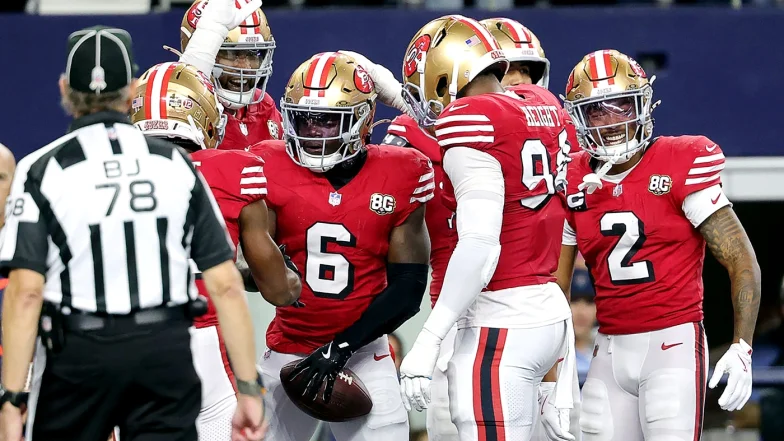
The San Francisco 49ers are off to an 8-1 start and are among the NFL's top teams. Their offense has been one of the league's most productive, giving them the ability to win games in a lot of ways.
However, their recent defensive performances have raised some concerns, particularly with the thought of the postseason looming.
Sunday's 46-40 victory over the Dallas Cowboys was another example. The 49ers put together an impressive offensive performance, totaling 584 yards and scoring 46 points. But the defense allowed 439 yards, including 343 through the air, and surrendered 40 points.
Dallas quarterback Dak Prescott threw for five touchdowns, while wide receiver George Pickens finished with 145 receiving yards and three touchdowns. The Cowboys also converted seven of 16 third downs and four of five fourth downs, making it difficult for San Francisco to get off the field.
The win improved the 49ers to 8-1, but the defensive performance highlighted a growing concern. After looking like one of the team's strengths early in the season, the defense has started to show some cracks.
The 49ers' Defense Has Taken a Step Back
The numbers show a noticeable difference between San Francisco's defensive performance early in the season and its recent results.
Through their first five games, the 49ers allowed an average of 18.6 points and 199.6 passing yards per game. Over their last four contests, those numbers have climbed to 25.8 points and 258.3 passing yards per game.
That's an increase of 7.2 points and nearly 59 passing yards allowed per game.
The difference is hard to ignore. While the defense was consistently limiting opposing offenses during the first part of the season, teams have found more success moving the football and putting points on the board in recent weeks.
The performance against Dallas was particularly concerning because of how much success Prescott and the Cowboys' passing game had. San Francisco struggled to consistently pressure Prescott, recording just one sack, and had a lot of difficulty containing Pickens and the rest of Dallas' receivers.
Although this game was an outlier for the defense, it followed a stretch in which opposing offenses have been producing at a much higher rate.
Red-Zone Defense Is Another Growing Concern
San Francisco's struggles haven't been limited to the overall yardage and points allowed. Its red-zone defense has also taken a step backward.
During the first six games of the season, opponents scored touchdowns on just 50% of their red-zone trips. That ranked fifth in the NFL. Over the last three games, that rate has increased to 60%, dropping the 49ers to 17th in the league during that stretch.
The defense has also allowed more points per red-zone trip, increasing from 4.39 to 5.00. Its expected points added per play has shifted from -0.09 during the first six games to +0.16 over the last three.
Those numbers show that opposing offenses are having a much easier time turning scoring opportunities into touchdowns.
The Cowboys took advantage of those opportunities on Sunday, scoring touchdowns on all three of their red-zone trips. When a defense struggles to get stops near the goal line, it puts even more pressure on the offense to answer with touchdowns of its own.
That might not be a problem every week with the way San Francisco's offense is playing, but it's not a formula the team should want to rely on in the postseason.
The Playoff Competition Won't Make Things Easier
The biggest concern with San Francisco's recent defensive struggles is the quality of offenses it could face in the NFC playoffs.
The NFC North, in particular, features several teams capable of putting up points. The Detroit Lions are averaging 28.6 points and 257.7 passing yards per game. The Chicago Bears are scoring 26.8 points per game, while the Green Bay Packers are averaging 268.1 passing yards per game.
Those numbers are especially relevant for a 49ers defense that has recently struggled to contain opposing passing games.
San Francisco could also run into familiar division rivals in the postseason. The Los Angeles Rams are averaging 24.8 points and 252.4 passing yards per game, while the Seattle Seahawks are producing 22.3 points and 218.5 passing yards per game.
Both teams have the potential to become much more dangerous if they enter the postseason healthy.
The margin for error becomes much smaller in January. An inability to generate pressure or a bad red-zone performance could be the difference between advancing and going home.
The 49ers Need Their Defense to Find Its Early-Season Form
There is still no reason for San Francisco to panic yet, though. An 8-1 record gives the team plenty of reason to be confident, and its offense has shown it can compete with anyone in the league.
Brock Purdy, Christian McCaffrey and the rest of the offense have provided plenty of production, and the 49ers are averaging 31.2 points per game, ranking second in the NFL.
But expecting the offense to consistently outscore opponents isn't a sustainable postseason strategy.
The defense doesn't need to be perfect, but it needs to become more consistent. Generating pressure, limiting explosive passing plays and getting stops in the red zone should all be priorities as the season moves forward.
San Francisco has shown what its defense can do. The first five games of the season provided a glimpse of a unit capable of keeping opposing offenses under control. Now, the challenge is getting back to that level before the competition gets even tougher.
The 49ers have the talent and offensive firepower to make a serious run at a Super Bowl. Whether their defense can keep up could ultimately determine how far they go.
More info on: Christian McCaffrey, Brock Purdy
Comments