Rep the Red & Gold: Shop 49ers Gear →

There are 395 users in the forums

Steve Young on the state of the 49ers

Shop Find 49ers gear online
Interesting comments from Charles Haley especially about Steve Young; it really sets the Tone for the era.

The Era of Excellence.

And then; how Camelot fell.

http://mmqb.si.com/mmqb/2016/10/21/nfl-charles-haley-bipolar-disorder-talking-football-themmqb

KAHLER: Looking back, how do you think your playing career would have been different if you had been diagnosed with bipolar disorder earlier?

HALEY: It probably would have helped me with my teammates. As a player, it didn't hurt me any because I learned to adapt my behavior to be able to focus and be able to help inspire my teammates to strive to something greater than the individual.

KAHLER: But one of the reasons you were traded to Dallas from San Francisco after the 1991 season was because of some arguments and fights you had with head coach George Siefert. If you had known you had bipolar disorder then, do you think your career might have played out differently?

HALEY: Yes, I do believe that. If I had truly listened to those that know better, some of the psychiatrists, even George Siefert, I think that I would [have stayed] there. He wanted me to be a leader and I didn't want that role. I liked the role of an antagonist, just prodding people to excellence. I hate weak men and I always try to stick my foot in their butt and twist. There is only one goal in life and that is to win.

KAHLER: Do you wish you had been diagnosed earlier in life?

HALEY: You have to understand this, and this is what I try to let others know: I didn't want people to know that I had a mental illness because of the stigma that goes with it. Every time a gunman shoots somebody, he has a mental illness; he's dealing with depression. But there are a lot of us who don't do that. Every time they do that, there are thousands of men [dealing with mental illness] that go back into the dark. As men, we don't want to tackle anything like that. We'd rather run out of gas than ask for help.

KAHLER: You write in your book that you think the 49ers had actually diagnosed you with bipolar disorder as early as your rookie season without telling you. The team gave you pills and claimed they were for inflammation or for headaches but when you asked around, no other players were taking the pills. Your theory is that those pills regulated your mood swings. Have you ever thought of asking anyone who was with the team at that time if your theory is true?

HALEY: I don't care. I just knew that, it's me, I should have taken responsibility for my actions. Ever since I was a kid, I was going through this stuff. In college it got worse, and in the NFL it got even worse. I never asked for help and it's my fault because I sit around and read the Bible from cover to cover three times a year and I understand that word faith. Faith is action and I didn't take any action to help myself or my teammates or the public to understand what I went through. I just knew that every time I turned around, somebody was calling me Dr. Jekyll and Mr. Hyde, because everyone thought I had all these different personalities. I took that personally.

KAHLER: You write that you wanted to kill yourself many times during your NFL career and after you retired. How many times did you feel that way?

HALEY: I'm going to tell you this, if I didn't believe in Jesus Christ and that if I committed suicide I would not be able have a relationship with him, I would not be here today. I didn't know how to be a friend—all I did was lock myself up in my house and hide from the world. When you live your life out of your head, then everything you think about starts to become a reality. If I didn't talk to people and let people know what was going on, I would say to myself, I'm tired of this, I'm tired of this, and the next thing you know, I'm tired of this and I'm going to do something. I would think about driving off a bridge

I would think about trying to do an accidental death that wasn't a suicide. But then I realized that God knows my heart and knows what I am thinking and for him that was something that I could not do. I never thought about my family and what that would cost them. I remember things like I would drive down McArthur [Boulevard] and cross the freeway and next thing I know I am driving my motorcycle down the embankment and I crossed all the way over Interstate 635 and got to the other side and somehow, I am still here. There were so many things that I did, but God had other plans for me and I think that I am fulfilling his wishes now by going out and talking to players, talking to college kids about mental illness and talking to parents. One of the biggest problems we have is the parents know what is going on with their son or daughter. They know, but they won't take any action. I am trying to put the pressure on the parents to step up and get involved with their kids and not try drive their kids to be a Hall of Famer or an NFL player, just help them to think through some of the problems they have.

KAHLER: Are there any teammates that you are a better friends with now than you were during your career because you had your wall up then?

HALEY: Steve Young is one of them. Me and Steve, we joked and played together. He understands what I'm going through and I get the chance now to hug his neck and tell him, You know what, I love you. The reason why I held things against him was that he was trying to take Joe's job and I loved Joe [Montana] so much that I took it out on Steve. I just wanted both of them to understand that I regret my actions and that they are true teammates of mine and I love them.

KAHLER: What specifically can teams do to help players more?

HALEY: Teams need to take some pages out of the 49ers' book. They take questionnaires and they ask guys what type of psychologist or counselor works best for you. For me, I have to have a woman and she has to have a Christian background, because she is my mama. That's the way my mama raised me, so I listen more to that kind of counselor. You can't have old white men or old black men trying to teach these young kids something because they don't identify with them. The 49ers have people walking through the locker room to get these guys to open up and talk. That's what we have to do in the NFL and that's what we have to do in our society. It's not one size fits all.
[ Edited by GoldenGateGlory on May 17, 2017 at 7:49 PM ]
The above videos are auto-populated by an affiliate.
Originally posted by GoldenGateGlory:
Oh, and of course we also shot ourselves in the foot by trading Charles Haley to the Dallas Cowboys as well.


More like shot ourselves in the face.

That was one of the stupidest things we ever did!
Has Steve commented on this year's draft yet??
Yes, he said we got some good hitters and Steve would know what a good hitter is.

Originally posted by GoldenGateGlory:
Interesting comments from Charles Haley especially about Steve Young; it really sets the Tone for the era.

The Era of Excellence.

And then; how Camelot fell.

http://mmqb.si.com/mmqb/2016/10/21/nfl-charles-haley-bipolar-disorder-talking-football-themmqb

KAHLER: Looking back, how do you think your playing career would have been different if you had been diagnosed with bipolar disorder earlier?

HALEY: It probably would have helped me with my teammates. As a player, it didn't hurt me any because I learned to adapt my behavior to be able to focus and be able to help inspire my teammates to strive to something greater than the individual.

KAHLER: But one of the reasons you were traded to Dallas from San Francisco after the 1991 season was because of some arguments and fights you had with head coach George Siefert. If you had known you had bipolar disorder then, do you think your career might have played out differently?

HALEY: Yes, I do believe that. If I had truly listened to those that know better, some of the psychiatrists, even George Siefert, I think that I would [have stayed] there. He wanted me to be a leader and I didn't want that role. I liked the role of an antagonist, just prodding people to excellence. I hate weak men and I always try to stick my foot in their butt and twist. There is only one goal in life and that is to win.

KAHLER: Do you wish you had been diagnosed earlier in life?

HALEY: You have to understand this, and this is what I try to let others know: I didn't want people to know that I had a mental illness because of the stigma that goes with it. Every time a gunman shoots somebody, he has a mental illness; he's dealing with depression. But there are a lot of us who don't do that. Every time they do that, there are thousands of men [dealing with mental illness] that go back into the dark. As men, we don't want to tackle anything like that. We'd rather run out of gas than ask for help.

KAHLER: You write in your book that you think the 49ers had actually diagnosed you with bipolar disorder as early as your rookie season without telling you. The team gave you pills and claimed they were for inflammation or for headaches but when you asked around, no other players were taking the pills. Your theory is that those pills regulated your mood swings. Have you ever thought of asking anyone who was with the team at that time if your theory is true?

HALEY: I don't care. I just knew that, it's me, I should have taken responsibility for my actions. Ever since I was a kid, I was going through this stuff. In college it got worse, and in the NFL it got even worse. I never asked for help and it's my fault because I sit around and read the Bible from cover to cover three times a year and I understand that word faith. Faith is action and I didn't take any action to help myself or my teammates or the public to understand what I went through. I just knew that every time I turned around, somebody was calling me Dr. Jekyll and Mr. Hyde, because everyone thought I had all these different personalities. I took that personally.

KAHLER: You write that you wanted to kill yourself many times during your NFL career and after you retired. How many times did you feel that way?

HALEY: I'm going to tell you this, if I didn't believe in Jesus Christ and that if I committed suicide I would not be able have a relationship with him, I would not be here today. I didn't know how to be a friend—all I did was lock myself up in my house and hide from the world. When you live your life out of your head, then everything you think about starts to become a reality. If I didn't talk to people and let people know what was going on, I would say to myself, I'm tired of this, I'm tired of this, and the next thing you know, I'm tired of this and I'm going to do something. I would think about driving off a bridge

I would think about trying to do an accidental death that wasn't a suicide. But then I realized that God knows my heart and knows what I am thinking and for him that was something that I could not do. I never thought about my family and what that would cost them. I remember things like I would drive down McArthur [Boulevard] and cross the freeway and next thing I know I am driving my motorcycle down the embankment and I crossed all the way over Interstate 635 and got to the other side and somehow, I am still here. There were so many things that I did, but God had other plans for me and I think that I am fulfilling his wishes now by going out and talking to players, talking to college kids about mental illness and talking to parents. One of the biggest problems we have is the parents know what is going on with their son or daughter. They know, but they won't take any action. I am trying to put the pressure on the parents to step up and get involved with their kids and not try drive their kids to be a Hall of Famer or an NFL player, just help them to think through some of the problems they have.

KAHLER: Are there any teammates that you are a better friends with now than you were during your career because you had your wall up then?

HALEY: Steve Young is one of them. Me and Steve, we joked and played together. He understands what I'm going through and I get the chance now to hug his neck and tell him, You know what, I love you. The reason why I held things against him was that he was trying to take Joe's job and I loved Joe [Montana] so much that I took it out on Steve. I just wanted both of them to understand that I regret my actions and that they are true teammates of mine and I love them.

KAHLER: What specifically can teams do to help players more?

HALEY: Teams need to take some pages out of the 49ers' book. They take questionnaires and they ask guys what type of psychologist or counselor works best for you. For me, I have to have a woman and she has to have a Christian background, because she is my mama. That's the way my mama raised me, so I listen more to that kind of counselor. You can't have old white men or old black men trying to teach these young kids something because they don't identify with them. The 49ers have people walking through the locker room to get these guys to open up and talk. That's what we have to do in the NFL and that's what we have to do in our society. It's not one size fits all.

Thanks 3G for finding this and sharing it. Never would have seen it otherwise. Fascinating stuff.
Yes, it is an amazing article. I do believe that Trade costs us 2 Superbowl wins.

Haley became a beast for Dallas who was our biggest foe during the era.

If he plays for us, the balance of power would have stayed on our side.

I still shed a tear when I think how Charles Haley left the 49er family and they couldn't help him with his bipolar disorder and chose to release him for a worthless 2nd rounder.

All Charles Haley did from then on was take vengeance on Steve Young.


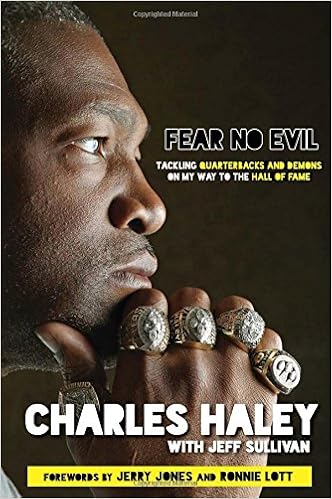
I suggest this book for anyone who loves the 49ers.

http://www.thepostgame.com/charles-haley-bipolar-disorder-depression-super-bowl

There are still ups and downs, and when I'm down, that can be pretty tough. It seems like it's mostly at night, when I'm alone and feeling worthless. I've been in those real, real dark places where I thought about killing myself. I had something I could be really good at with football, but then when that's gone, it's hard to find yourself. So I went to those terribly dark places in my mind. What kept me from killing myself is that I realized I couldn't have a relationship with Jesus Christ if I committed suicide. That always brought my head up.

I go to a psychiatrist and a counselor now. I sit down and I'm open and honest. Holding it in, that's what I did my whole life. I internalized everything somebody said, everything somebody did, and then guess what? I couldn't let it go.

I always sensed that somebody was going to attack me, so I attacked first. One of the best moments of my life -- this was five years ago or so -- I was talking to Emmitt Smith, the all-time leading rusher in NFL history and my former teammate with the Dallas Cowboys. He said something and I just started to attack him. And he says, "Charles, you won't let anyone be your friend."

I walked away and I thought about that. He was right. When I got around guys, I might say one, two things, and then -- boom -- the pit bull came out. I appreciated Emmitt helping me understand what I was doing. I'm sure a lot of my former teammates wish I had figured that out about 20 years earlier. The worst part of being bipolar is that I've scared my family, my ex-wife Karen, and my four kids because of the hopelessness and worthlessness that I felt. Even though I've done so many great things, I couldn't see it, and that's when I knew that something was wrong.

You know, a lot of people have depression and don't have an outlet. Playing football, watching film, just being around my teammates -- even if I didn't feel like talking with them that particular day -- that was my outlet. There were days I would wake up and just want to stay there in my bed or on the couch watching cartoons and pretend the world didn't exist. That's how depression works

them that particular day -- that was my outlet. There were days I would wake up and just want to stay there in my bed or on the couch watching cartoons and pretend the world didn't exist. That's how depression works. During the season, however, at least I had football. That would get me up and dressed and out the door. Without football, there's no telling where my life would have ended up.Nowadays, when I start feeling depressed, I go to Starbucks, open the doors, and I buy somebody something. I try and reach out to people who know me, and we get into a conversation. They start talking about their kids, their family, and now I'm not thinking about my past or how I'm feeling. I'm thinking about how somebody else is feeling, so it takes me out of my own world.

It's tragic that the human mind can work that way. I mean, look, no one needs to tell me how fortunate I have been after coming from a childhood without indoor plumbing in Gladys, Virginia. And it's all because of football, a game I loved playing more than words can explain.
http://www.espn.com/blog/san-francisco-49ers/post/_/id/25079/finding-fits-in-defense-among-49ers-primary-ota-objectives

The start of OTAs is the closest thing the Niners will get to real football in the offseason program, as players will participate in actual field work including 9-on-7, 7-on-7 and 11-on-11 drills. There's no live contact permitted but it's the first real chance for coach Kyle Shanahan to see his team in a football setting.

Monday's workout will be the first of 10 OTAs for the 49ers, with the others scheduled for May 23, 25, 30, 31 and June 2, 5, 6, 8 and 9. They'll wrap up the offseason program with a mandatory veteran minicamp June 13-15.

With those sessions still ahead, here's a look at what the Niners have to work through in the coming weeks:

The 49ers plan to experiment with Arik Armstead at the "Leo" defensive-end position. Photo by Gavin Baker/Icon Sportswire1. Sifting through the pass rushers: At the end of the NFL draft, Shanahan and general manager John Lynch spoke openly about the need to figure out who their best pass rushers are. Taking it a step further, they also need to figure out where the candidates for those pass-rushing roles fit best. In coordinator Robert Saleh's 4-3 defense, the best pass rushers traditionally play the "Leo" defensive-end spot, SAM linebacker and three-technique defensive tackle.

DeForest Buckner is the odds-on favorite to play three-technique and Ahmad Brooks is the best bet to handle the strong-side linebacker spot. But the "Leo" looks to be up for grabs. The Niners plan to experiment with Arik Armstead at the position. Though that looks to be a strange fit from the outside, the 49ers believe it could work. Other players, such as Ronald Blair, Aaron Lynch, Tank Carradine, Pita Taumoepenu and Eli Harold, could get looks there and some of those players could get reps at SAM as well.

With plenty of time left between now and the season, the 49ers don't have to come out of these OTAs with definitive answers for any of these spots, but the sooner they can get a good idea of who will line up where, the better off they'll be.

2. Coveting a cornerback: The Niners released projected starting corner Tramaine Brock after he was arrested on suspicion of domestic violence. Then they used a third-round pick on Ahkello Witherspoon in the NFL draft in the search for a replacement. As things stand now, only Rashard Robinson looks to have a solid grip on a starting outside-corner job, which means Brock's former spot is up for grabs.

Dontae Johnson got the bulk of the work there with the first team at the team's pre-draft minicamp, but things should heat up now that Witherspoon has been added to the mix. Witherspoon profiles as the ideal cover corner in Saleh's scheme, but he must be more physical as a tackler in order to win the job. This battle likely comes down to Witherspoon, Johnson or possibly Keith Reaser but it could last well into camp as Witherspoon gets more comfortable.

3. Tackling tight end: The 49ers have at least six players capable of playing at tight end and there doesn't appear to be anything set in terms of how those options will be used or in what order. Vance McDonald, Garrett Celek and Blake Bell are returning while Logan Paulsen and rookies George Kittle and Cole Hikutini are joining the fray. Fullback Kyle Juszczyk could also work at tight end.

After the draft, Shanahan and Lynch openly discussed their efforts to trade McDonald, which makes his future with the team somewhat tenuous. The same could be said for Celek and Bell. Paulsen is a solid blocker and will get work in that role while Kittle and Hikutini will get chances as the "move" tight end.

The Niners will probably keep no more than four tight ends and it could be just three given Juszczyk's versatility.

4. Line dancing: The 49ers mostly stuck with what they have on the offensive line but did make a couple of veteran additions in the offseason. The trade for Jeremy Zuttah was the most intriguing addition and he could compete at center and/or left guard. Incumbents Daniel Kilgore and Zane Beadles won't cede those spots easily but Zuttah could be a better fit in Shanahan's offense. At right tackle, Trent Brown is returning and expected to start but Garry Gilliam was brought in to add competition.

Because live contact is not allowed in OTAs, settling on the starting offensive line over the next few weeks is unlikely. But considering the importance of continuity and chemistry in the front five, it's imperative to at least get a rough outline sooner than later.

5. Shortening the learning curve: The 49ers won't have either of their two first-round picks participating in OTAs as league rules don't allow defensive lineman Solomon Thomas at the facility until his Stanford class is finished with school and linebacker Reuben Foster is recovering from shoulder surgery. That will mean a slower acclimation come training camp, but this is also an important time for Shanahan and Saleh to begin installation of their respective systems.

Shanahan's offense is considered among the more complicated in the league, which means there will be a lot of work for the new additions. The good news is that players like quarterback Brian Hoyer, receiver Pierre Garcon, Paulsen and others have experience in the scheme. That should help those who are new to it learn faster.

On a macro level, there's always an adjustment when a new coaching staff steps in as players learn what is expected of them and coaches learn what players do best.
Novelist Michael Chabon wrote recently in the New Yorker on nostalgia: "Nostalgia is a valid, honourable, ancient human emotion, so nuanced that its sub-variants have names in other languages – German's sehnsucht, Portuegese's saudade – that are generally held to be untranslatable."

You can see the appeal, I guess. Nostalgia and the music of your youth are like a warm bath. Who'd want to get out, particularly when the last couple of years feels like black days.
Originally posted by GoldenGateGlory:
Novelist Michael Chabon wrote recently in the New Yorker on nostalgia: "Nostalgia is a valid, honourable, ancient human emotion, so nuanced that its sub-variants have names in other languages – German's sehnsucht, Portuegese's saudade – that are generally held to be untranslatable."

You can see the appeal, I guess. Nostalgia and the music of your youth are like a warm bath. Who'd want to get out, particularly when the last couple of years feels like black days.

Right...
Originally posted by Matchuu84:
Originally posted by Truman49:
http://www.knbr.com/2016/12/14/steve-young-losses-dont-matter-to-the-yorks-because-they-are-making-money/

http://www.knbr.com/2016/12/14/young-disagrees-with-dilfer-on-trent-baalkes-resume/

He has discussed the importance of team identity and leadership for years. He summed up the issues with the 49ers perfectly: Ownership only cares about making money, and the team will ultimately fail (no matter the GM or Coach) without a strong team identity and leadership.

He may not have the experience to be a GM, but there must be a role for Steve Young on the 49ers.

His role is a critic.

When x players/coaches can make it as a nfl commentators, analysts... no reason to coach gm ect too much work for similar money

LOL. Just saw this. The irony....
Sibelius: Never pay any attention to what critics say. Don't forget there has never been a statue set up in honor of a critic.

Steve Young is the perfect critic because he can be not happy with everything but has no solutions or if he has a solution and someone then implements his solution and it doesn't work; he is critical of them for their implementation.

He can criticise all the way to the end of the line by warping his argument and twisting it to suit the situation but if you listen to him at the start of the season and at the end of the season he can actually be arguing the exact opposite thing but no one can see the metamorphose of his argument changing through the season.

That is the art of being a good critic.

To be able to argue the exact opposite point from one day to the next without having anyone call you on it.

Just like him balancing the ball on his finger.

Great but it is meaningless in the context of throwing a football..

Cannon fodder for the Armageddon

Visual ice cream for those who have stuffed themselves with too much chocolate.

Originally posted by GoldenGateGlory:
Sibelius: Never pay any attention to what critics say. Don't forget there has never been a statue set up in honor of a critic.

Steve Young is the perfect critic because he can be not happy with everything but has no solutions or if he has a solution and someone then implements his solution and it doesn't work; he is critical of them for their implementation.

He can criticise all the way to the end of the line by warping his argument and twisting it to suit the situation but if you listen to him at the start of the season and at the end of the season he can actually be arguing the exact opposite thing but no one can see the metamorphose of his argument changing through the season.

That is the art of being a good critic.

To be able to argue the exact opposite point from one day to the next without having anyone call you on it.

Just like him balancing the ball on his finger.

Great but it is meaningless in the context of throwing a football..

Cannon fodder for the Armageddon

Visual ice cream for those who have stuffed themselves with too much chocolate.


I grew up with Montana being born in 1970.

I like young but he just didn't seem to perform well in the big games.
Great regular season QB, but seemed to choke in the playoffs.
Between the packers and the cowboys, I never thought we would win one with Young at QB.
Steve Young was mentally soft in a crisis while Joe Montana was mentally tough.

Steve young used to suffer from terrible anxiety.

When things were going Steve Youngs way; he could do anything but when it got too hard, he disengaged and tried to push things that weren't there.

http://www.espn.com.au/nfl/story/_/id/17787665/wrong-how-san-francisco-qb-steve-young-played-anxiety-nfl

This story is excerpted from "QB: My Life Behind the Spiral" by Steve Young with Jeff Benedict. To buy the book, click here.

In Week 2 of the 1993 season, we traveled to Cleveland to play the Browns on Monday Night Football. Stomach problems continued to dog me, and early in the game, I took a pretty good shot that left a deep bruise on my left thigh. Cleveland was a lousy team. But it was as if Cleveland's defense knew our plays in advance. We couldn't figure out how they were doing it. I threw three interceptions and we lost 23-13.

It was a long flight back to San Francisco. My left thumb, left elbow and left thigh were all hurting. By the time I got to my loft it was five in the morning. I was so beat I didn't bother undressing and collapsed on my bed. But I couldn't sleep. My mind wouldn't let me. Losing to Cleveland? Unacceptable. Starting the season 1-1? Unacceptable. Six interceptions in the first two games? Unacceptable.

My thumb wasn't right. My elbow was sore. My stomach was a mess. I was fatigued. I had to play better.

I tossed and turned all night. I was still awake at dawn. Panic set in. My body craved sleep, but my mind wouldn't wind down. I closed the curtains, pulled a pillow over my head, and finally dozed off. But the slightest flinch woke me.

At 10, I crawled out of bed. My thigh felt like one giant charley horse. I gazed into a mirror and saw a man buckling under the weight of the world. The 49ers had to win this year. I had to deliver.

My outlook was perplexing. On the one hand, I had incredible confidence in my ability as a quarterback. I was the MVP of the league. Yet I felt tethered to a ball and chain. I was the quarterback of a Super Bowl-caliber team. I knew what had to be done. But in the second week of the regular season I already felt the heaviness of anxiety.
I went back to my bed and dropped to my knees and pleaded with God for help. I didn't want to do this anymore. But I also didn't want to quit. I still wanted to find out how good I could become. In the aftermath of Joe Montana, San Francisco was the hardest place in the world for a quarterback to play. But I still wanted to know: How far can I go?

  • Giedi
  • Veteran
  • Posts: 33,762
Originally posted by GoldenGateGlory:
Steve Young was mentally soft in a crisis while Joe Montana was mentally tough.

Steve young used to suffer from terrible anxiety.

When things were going Steve Youngs way; he could do anything but when it got too hard, he disengaged and tried to push things that weren't there.

http://www.espn.com.au/nfl/story/_/id/17787665/wrong-how-san-francisco-qb-steve-young-played-anxiety-nfl

This story is excerpted from "QB: My Life Behind the Spiral" by Steve Young with Jeff Benedict. To buy the book, click here.

In Week 2 of the 1993 season, we traveled to Cleveland to play the Browns on Monday Night Football. Stomach problems continued to dog me, and early in the game, I took a pretty good shot that left a deep bruise on my left thigh. Cleveland was a lousy team. But it was as if Cleveland's defense knew our plays in advance. We couldn't figure out how they were doing it. I threw three interceptions and we lost 23-13.

It was a long flight back to San Francisco. My left thumb, left elbow and left thigh were all hurting. By the time I got to my loft it was five in the morning. I was so beat I didn't bother undressing and collapsed on my bed. But I couldn't sleep. My mind wouldn't let me. Losing to Cleveland? Unacceptable. Starting the season 1-1? Unacceptable. Six interceptions in the first two games? Unacceptable.

My thumb wasn't right. My elbow was sore. My stomach was a mess. I was fatigued. I had to play better.

I tossed and turned all night. I was still awake at dawn. Panic set in. My body craved sleep, but my mind wouldn't wind down. I closed the curtains, pulled a pillow over my head, and finally dozed off. But the slightest flinch woke me.

At 10, I crawled out of bed. My thigh felt like one giant charley horse. I gazed into a mirror and saw a man buckling under the weight of the world. The 49ers had to win this year. I had to deliver.

My outlook was perplexing. On the one hand, I had incredible confidence in my ability as a quarterback. I was the MVP of the league. Yet I felt tethered to a ball and chain. I was the quarterback of a Super Bowl-caliber team. I knew what had to be done. But in the second week of the regular season I already felt the heaviness of anxiety.
I went back to my bed and dropped to my knees and pleaded with God for help. I didn't want to do this anymore. But I also didn't want to quit. I still wanted to find out how good I could become. In the aftermath of Joe Montana, San Francisco was the hardest place in the world for a quarterback to play. But I still wanted to know: How far can I go?


I remember Joe spotting John Candy on the sidelines. No anxiety disorder for Joe there. I think Joe loved playing football so much, he forgot to be anxious.
Open Menu Search Share 49ersWebzone