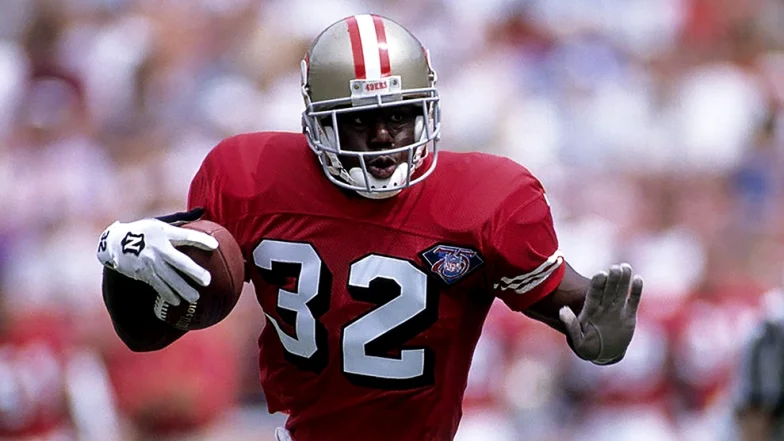
Ricky Watters can arguably be considered one of the top five running backs in San Francisco 49ers history, despite spending only a relatively short time with the team.
Some would argue that, had Watters remained in San Francisco, he could have potentially broken Joe Perry's franchise rushing record, helped lead the 49ers to multiple Super Bowl victories, and perhaps even built a strong enough résumé to earn a place in the Pro Football Hall of Fame.
His presence provided the team with a consistent running game and a reliable threat out of the backfield, giving the offense another dynamic weapon to complement its passing attack.
Although he missed the entire 1991 season because of a hand injury, Watters made an immediate impact on the 49ers offense the following season, rushing for 1,013 yards and nine touchdowns.
He also caught passes for 405 yards and added two receiving touchdowns.
The following season, Watters fell just short of another 1,000-yard rushing campaign, finishing with 950 yards and 10 touchdowns in just 13 games.
His production helped the 49ers secure the No. 2 seed in the NFC and earn a home playoff game against the New York Giants, where Watters would deliver his best performance as a member of the team.
The last time the 49ers and Giants had met in the playoffs was in 1990, when New York ended San Francisco's hopes of a three-peat by defeating the 49ers 15–13 in the NFC Championship Game.
The Giants won the coin toss but elected to defer, giving the 49ers the ball to start the game.
The 49ers took the opening kickoff and scored on an eight-play drive, capped by a Ricky Watters 1-yard touchdown run. Kicker Mike Cofer missed the extra point, leaving San Francisco with a 6–0 lead over the G-Men.
The Giants went three-and-out on their first possession, forcing a 54-yard Mike Horan punt. Backup running back Dexter Carter returned it 31 yards to the Giants' 48-yard line.
The 49ers offense moved the ball to the Giants' 11-yard line, but the drive stalled, forcing San Francisco to settle for Cofer's 29-yard field goal and extend its lead to 9–0.
Newly acquired safety Tim McDonald then intercepted Giants quarterback Phil Simms, giving the 49ers offense possession at the Giants' 41-yard line.
The 49ers capitalized on the turnover, with Watters punching the ball in from one yard out for his second touchdown of the game and extending San Francisco's lead to 16–0.
Both teams went three-and-out on their next possessions.
The Giants managed to pick up a first down on their following drive but were ultimately forced to punt, pinning the 49ers deep inside their own territory at the 8-yard line and giving San Francisco its worst starting field position of the game.
Steve Young then directed the 49ers offense on a nine-play drive that ended with a 2-yard Watters touchdown run, increasing the lead to 23–0.
The Giants finally got on the scoreboard before halftime when David Treadwell connected on a 25-yard field goal, cutting the 49ers' lead to 23–3.
At the start of the third quarter, both teams traded punts until the 49ers got their offense rolling again. San Francisco finished a seven-play drive with a 6-yard Watters touchdown run, extending its lead to 30–3.
The Giants' offense continued to stall after failing to pick up a first down on fourth-and-3, giving the ball back to the 49ers. Watters then scored his fifth touchdown of the game on a 2-yard run, increasing San Francisco's lead to 37–3.
A Marc Logan 2-yard touchdown run in the fourth quarter put the game completely out of reach, sealing a 44–3 victory and officially ending the Giants' season.
With the victory, the 49ers advanced to the NFC Championship Game, where they faced—and lost to—the defending and eventual two-time Super Bowl champion Dallas Cowboys.
Watters finished the game with 118 rushing yards, 46 receiving yards, and a playoff-record five rushing touchdowns.
The game also marked the final appearance of Giants all-time great linebacker Lawrence Taylor, who was virtually nonexistent throughout the entire game.
Watters remained a key contributor the following season, helping the 49ers win Super Bowl XXIX. He scored three touchdowns in San Francisco's 49–26 victory over the San Diego Chargers.
Unfortunately, Watters left San Francisco during the following offseason after signing a three-year, $6.9 million contract with the Philadelphia Eagles. The 49ers were unable to match Philadelphia's offer, bringing his time in San Francisco to an end.
According to the article "Eagles make Watters an offer he can't refuse," 49ers Director of Football Operations Dwight Clark was comfortable letting Watters leave, believing promising young running back Derek Loville was just as capable as a runner, while acknowledging that Watters was just as exceptional out of the backfield catching the ball.
There remains considerable debate over whether Watters deserves a place in the 49ers Ring of Honor.
Despite missing his entire rookie season, the former Notre Dame Fighting Irish standout running back made a significant impact during his four years in San Francisco. He rushed for 2,840 yards, added 1,450 receiving yards, scored 33 total touchdowns, and earned three Pro Bowl selections.
Watters currently ranks 15th in 49ers franchise history in rushing yards. During his 10-year NFL career, he was selected to five Pro Bowls, rushed for 11,309 yards, recorded 4,699 receiving yards, and scored 103 total touchdowns during the regular season and playoffs.
All statistics and research for this article are from Pro Football Reference, StatMuse, and the Deseret News.
Comments