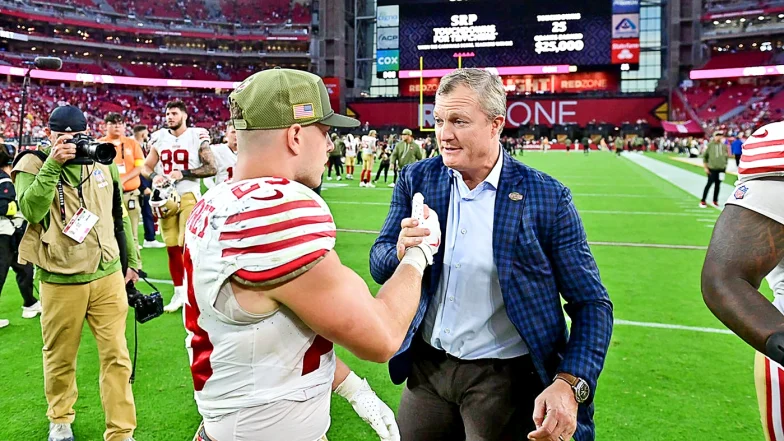
I recently wrote an article on general manager John Lynch's performance in the draft. One thing that stands out is how poorly he does in the early rounds and how well he does in the later ones.
How does a talent evaluator miss so badly in the second round with wide receiver Dante Pettis and come up with a gem in Jauan Jennings in the seventh? Why did The Faithful have to suffer through the non-performance of first-round pick defensive tackle Javon Kinlaw yet enjoy the excellent play of DJ Jones, who was taken in the sixth?
I have a theory.
All teams have to decide whether to draft for need or for the best player available. In the early rounds, there is often the feeling that the two can be addressed with one player. This is particularly true in the first round.
In this analysis, I am not going to simply identify who was available. Anyone can look at the 2023 draft and exclaim, "Why did the Panthers take wide receiver Jonathan Mingo at the top of the second round when Puka Nacua was available all the way in the fifth?"
I am going to look at players who were passed on but were considered better at the time than the player Lynch selected.
It is my feeling that Lynch does poorly early and well late because he drafts for need early and looks only at talent later. There is often a fear that a difference maker at a need position can't or won't be found in later rounds.
In Lynch's first draft, he took defensive lineman Solomon Thomas with the third overall pick. He and head coach Kyle Shanahan felt the defensive line was a big need and had to be addressed. At the time, one available player was running back Christian McCaffrey.
McCaffrey was considered better than Thomas on most draft boards. Shanahan loved him and thought he would be a perfect fit for his offense. But the defensive line was the bigger need, so they went with it.
Question: Does anyone believe San Francisco would have lost to the Chiefs in the Super Bowl following the 2019 season if Christian McCaffrey had been in the backfield instead of Tevin Coleman and Matt Breida?
In 2018, the offensive line was a need, and Lynch drafted Mike McGlinchey. McGlinchey was a solid player, but he was not as highly touted as safety Minkah Fitzpatrick or defensive tackle Vita Vea. Safety was somewhat of a need at the time, but the 49ers were in pretty good shape along the D-line.
McGlinchey has been average. Vea is a Pro Bowler. But what about the offensive line? Brian O'Neill was available when San Francisco picked in the second round, and he went to the Pro Bowl. McGlinchey still has not.
Just imagine a defensive line with Vita Vea next to DeForest Buckner and a tackle tandem of O'Neill and Joe Staley.
Analyzing 2019 is easy. Nick Bosa was considered one of the best defensive ends in years. It was a need position, and the 49ers had the number two pick.
But in 2020, Lynch had traded Buckner due to contract demands, and the GM felt a real need to fill that hole. Kinlaw was considered solid, but he wasn't considered a dominant player, the way Buckner was when he came out of college.
Two players consistently ranked higher than Kinlaw. They were wide receiver CeeDee Lamb and offensive tackle Tristan Wirfs. Lynch later drafted Brandon Aiyuk, but even at his best, Aiyuk did not strike fear into opposing secondaries as Lamb does. Yes, Lynch had made the mistake of drafting McGlinchey, but even so, Wirfs is an All-Pro. And if McGlinchey had not been selected, the need would have been there.
Joe Staley had retired before that draft, and John Lynch traded for Trent Williams. Oh, dear reader, can you imagine a tackle tandem of Trent Williams and Tristan Wirfs? Yes, it was not the obvious need, but the talent level should have overcome the urge to find Buckner's replacement.
And what if Lynch had gone with Lamb? How much sleep would defensive coordinators have lost the week before facing a Lamb and Deebo Samuel pairing?
In 2021, Lynch went all in for quarterback Trey Lance. Kyle Shanahan has admitted that he preferred Mac Jones for most of the process but overthought it and decided on Lance. If the 49ers had stayed put and taken Jones, they would not have given up that draft capital.
But this is not about that kind of decision.
At the time, Jimmy Garoppolo was still on the team and had taken the 49ers to the Super Bowl—and nearly won it—just two years prior. Who was available at No. 12 who was not a quarterback and who was considered better than those two?
Parsons was considered a generational talent and certainly one of the best players at any position in the draft. Lynch still keeps looking for someone to pair with Nick Bosa on the other side of the defensive line. Can you imagine the pass rush generated by Bosa and Parsons? The NFL might have had to change the rules to offset that mismatch.
Only two years ago, the Niners drafted Ricky Pearsall. I like Ricky, and he has played well when healthy, but Cooper DeJean was available. And DeJean is an All-Pro.
In the later rounds, however, Lynch is a master at finding the stars others see as role players. Fred Warner lasted until the third round. Eight linebackers had been selected before him. But Lynch understood the speed necessary for the Niner defense. He looked at traits. Reuben Foster's off-field issues had begun to show themselves, and Lynch could have felt pressure to go with a linebacker early.
But he didn't. He didn't force it with, for instance, Leighton Vander Esch in the first round. Vander Esch was a good linebacker in Dallas before his injuries, but he was never in Fred Warner's league. Lynch waited and got a superstar.
With his steals, Lynch has not looked at filling holes. In 2019, San Francisco had Fred Warner and had signed Kwon Alexander. But Lynch felt Dre Greenlaw had the traits to be a good linebacker and drafted him in the fifth round.
In 2020, Lynch had already drafted a receiver in the first round, and Deebo Samuel was on the team. But Lynch saw a mismatch-maker in Jauan Jennings and ignored his 40 time, taking him in the seventh round. Both of those players have played critical roles in the Niners' success.
John Lynch is an excellent talent evaluator, but he forgets that side of the equation in the early rounds and tends to go with need rather than best player available.
For a 12-5 team, the Niners have several needs this year. I would be happy (thrilled?) with an offensive lineman in the first round. (Or the second.) Both positions on the defensive line, especially in the middle, are needs. And if Jauan Jennings leaves in free agency (and really, even if he doesn't), wide receiver will be a big need.
But if someone not at a position of need—a linebacker, for instance, or a safety—is a better player, it might be well worth going that route.
Great players are called difference makers for a reason. Even if a team has a solid player at a position, a difference maker will improve the team more than a pretty good player at a position of need will.
John Lynch would do well to remember that in the early rounds this April.
More info on: Nick Bosa, Dre Greenlaw, Mac Jones, Christian McCaffrey, Ricky Pearsall, Dante Pettis, Deebo Samuel, Fred Warner, Trent Williams
Comments