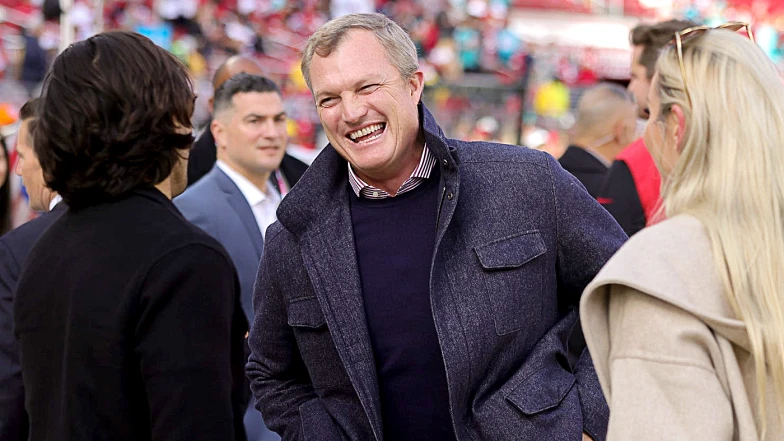
San Francisco 49ers beat writer Grant Cohn recently wrote an article on how poor general manager John Lynch is in drafting. Cohn looks at the first three rounds, and though he makes a counting error (he says Lynch has taken 41 players when it is 30), he is not wrong that Lynch has not been stellar and has made some notable misses.
But to be truly accurate and get a better sense of Lynch's performance, you need to go into a deeper analysis.
First, I do not think it is fair to include a rookie class as evidence of "misses." In the first three rounds from last year, Upton Stout (third round) started at nickel cornerback and did a good job. Second-round defensive tackle Alfred Collins showed potential and should be better next season. And Lynch's first-round pick, defensive end Mykel Williams, was coming along nicely when he suffered a season-ending knee injury. Let's see how he plays when he returns.
There are the stars—Nick Bosa, Fred Warner, Deebo Samuel, and Brandon Aiyuk—and wide receiver Ricky Pearsall has played outstanding football when he has been healthy. Current guard Dominick Puni is a keeper.
That said, Mike McGlinchey, a former ninth overall pick, and Aaron Banks, a second-rounder, should not be players a GM lets walk because they just aren't worth the money when they hit free agency.
The rest of the lot were pretty poor, also, and there were the infamous hyper-busts Solomon Thomas and Trey Lance, the latter of whom cost San Francisco several high draft picks.
The other noteworthy part of Lynch's record in the first three rounds is how many players were injured. Defensive linemen Javon Kinlaw, a first-rounder, and Drake Jackson, a second-rounder, rarely saw the field. And those are high picks to spend when they had injury issues in college.
Wide receiver Jalen Hurd (a third-rounder, also with injury problems at the college level) was gone before his first training camp was over, and Nick Martin (a third-round pick this past April) suffered a bad injury in college, though time will tell on him.
Lynch needs to avoid making risky choices, and this year, after the season the 49ers just finished, he really doesn't need to select anyone who has even had a fingernail problem last year.
To judge Lynch fairly, we have to look at his draft record overall, and this is where it gets strange. Most poor evaluators are bad throughout the draft, but John Lynch has been exceptional in the later rounds. These players were all taken on day three:
- George Kittle (All-Pro)
- Talanoa Hufanga (All-Pro)
- Dre Greenlaw (just missed the Pro Bowl)
- Deommodore Lenoir
- Jauan Jennings (selected in the seventh round!)
- DJ Jones (added in the sixth round)
And San Francisco's star quarterback, Brock Purdy, was taken with the last overall pick in the 2022 NFL Draft.
There were other very good players and/or role players Lynch took in those later rounds. Current starting linebacker Dee Winters was selected in the sixth. Mitch Wishnowsky, a very good punter, was a fourth-round selection. Cornerback DJ Reed has started for several teams, but was released by the 49ers early in his career before he really developed. And running back Elijah Mitchell was an excellent starter before Lynch traded for Christian McCaffrey.
Of the 47 players Lynch selected on day three, 11 have either been to a Pro Bowl or been significant starters for the 49ers or another team. Three of those—Greenlaw, Hufanga, and Jones—were key to the Denver Broncos' second-ranked defense (total yards allowed) this season. So roughly one out of every four late-round picks might start and produce at a high level.
And then, there are the undrafted free agents Lynch has signed. Linebacker Azeez Al-Shaair, running backs Jordan Mason and Matt Breida, and wide receiver Kendrick Bourne were all picked up after the draft. Al-Shaair is a standout on Houston Texans head coach Demeco Ryan's top-ranked defense (total yards allowed).
We knew Ryans was likely going to poach Al-Shaair since he knew him from their time together with the Niners, and San Francisco did not have the money to pay three excellent linebackers in Warner, Greenlaw, and Al-Shaair.
In fact, of the 10 highest-paid players on the team, five were taken on day three (another, Fred Warner, in the third round), and two were acquired via trade (All-Pro left tackle Trent Williams and All-Pro running back Christian McCaffrey). Only two—Aiyuk and Bosa—were taken early, which does not speak well of Lynch's expertise in the early rounds.
Another way to look at Lynch's performance is how well he has selected various position groups.
On the defensive line, he has not done well, with Bosa and DJ Jones the only two solid starters (though the jury is decidedly out on Mykel Williams, Collins, and one of last year's fourth-round selections, CJ West).
On the other hand, Lynch has done well with pass catchers. Of the six wide receivers selected, two have been All-Pros, one has shown promise, and if you add tight end George Kittle, who might one day wear a gold jacket, and Jauan Jennings, you have to give Lynch credit for giving his quarterbacks weapons to throw to.
He has also done well with linebackers. Warner, Greenlaw, and Al-Shaair were one of the best units in the league when they were together. Winters has been a solid starter and is ascending. Tatum Bethune (a seventh-round pick) is a good backup.
But then it gets bizarre. Why is it that the earlier John Lynch takes a running back, the worse that ball carrier is? Trey Sermon and Ty Davis-Price, third-round picks in back-to-back years, were off the team almost immediately. In contrast, sixth-round pick Elijah Mitchell and undrafted free agents Jordan Mason and Matt Breida all played at a high level. The 49ers lost Mason because, understandably, undrafted free agents don't take team-friendly deals when they become free agents.
I understand if a GM is terrible at selecting players from a particular position, but why is Lynch so good at evaluating the supposed "dregs" of the draft pool and so bad when there is a larger group to choose from? Every year, I pray he won't draft a running back in the first two days.
So there you have it. A new outlook on the 2026 season is roughly three months away. As always, I will watch every round and try to be excited about the picks on the first two days. But it is clear from the past nine years that, for the 49ers, day three is when you need to tune in.
And this year, San Francisco has four picks on day three. Be sure to check out the superstars who are likely to receive a phone call from Lynch that Saturday.
Comments